RUBRIC WISE
Repertory Apps & Software
for Homeopaths & Home Prescribers
A look at the tools available for repertory work so you can choose software and apps that support your clinical thinking.
Part One - Professional Software
LAST REVIEWED AUGUST 2026
Choosing repertory software is a big decision, and I know how much thought goes into it. I've been in the same position as most students, trying to determine which software suits my needs and how I want to practice.
That is what this page is for.
I spent four years working with RadarOpus as a student and I still use RadarOpus today and love it. Since 2025 I have also been exploring Similia, the newest repertory software which keeps evolving and improving based on what its users ask for. Both are incredible systems and I get genuinely nerdy about them.
Because I know these two systems best, much of my content on social media is based on these systems.
I share my own experience and opinion and I would always encourage you to look at each program directly before you buy. I will share what I learn, as tools continue to grow and evolve, and update this page accordingly.
Click the software logos to visit their sites.
RadarOpus
The longest-running name in homeopathic software and the only place you will find the Synthesis repertory. A full desktop suite that works entirely offline, with packages that scale from a single repertory up to the complete English library.
Type: Desktop suite, offline capable
Best for: Practitioners who want Synthesis, and anyone who prefers to own their software outright
Platforms: Windows and macOS
Price: One-time lifetime licence, tiered by package. Payment plans and rental available. Student and graduate pricing on request.
Synergy
Formerly Kent Homeopathic, and the home of MacRepertory and ReferenceWorks. Synergy Viva brings both into one interface and adds the Reliable Repertory, where every rubric and remedy addition has been traced back to a confirmed source. Add-on modules include an AI study assistant, note syncing and margin annotations.
Type: Desktop suite with add-on modules
Best for: Students who want source-verified rubrics and a strong graphical analysis tradition
Platforms: Windows and macOS
Price: One-time purchase, tiered by edition. A dedicated student edition is available.
Similia.io
A modern browser-based platform with a free tier that does not expire. Semantic search lets you describe a symptom in your own words rather than hunting for the exact rubric wording, and the paid tiers add Complete Repertory 2026, Murphy's MetaRepertory or the Saine Repertory depending on which edition you choose, with many additional options by subscription or one time purchase (QRep, The Lacs and so on).
Type: Web-based, works on any device with a browser
Best for: Students who want to start free and add depth as they go
Platforms: Any modern browser, desktop or mobile
Price: Free forever tier. Pro tiers on monthly subscription. Student and educator pricing available on request. Rubric Wise Affiliate Code for 10% Discount: RUBRICWISE

Complete Dynamics
Built by Roger van Zandvoort, the author of the Complete Repertory, alongside software developer Eduard van Grinsven. The free Browser Edition gives you the entire Complete Repertory to read and study at no cost, and the paid editions add analysis, case management and materia medica. Runs on more operating systems than anything else on this list, and upgrades and support are included.
Type: Desktop program with matching mobile app
Best for: Anyone working primarily from the Complete Repertory, and anyone who moves between devices
Platforms: Windows, macOS, Linux, iOS and Android
Price: Free Browser Edition. Practitioner and Master editions on monthly subscription, upgrades included.
Hompath Zomeo
One of the largest libraries available in a single package. Editions run from a student-focused Academic version up to Ultimate, which carries the full repertory and book collection alongside practice management tools.
Type: Desktop suite with practice management, accompanying mobile apps
Best for: Students who want the widest library and built-in expert systems in one purchase
Platforms: Windows
Price: One-time purchase, tiered by edition. Academic edition priced for students. Free trial available.


Vision
A UK-built program from Miccant, sold as a one-time purchase. Vision carries the Complete Repertory alongside a broad choice of add-on repertories including Sherr's Q-Rep, Knerr, Murphy and Saine. Miccant also makes Akiva for acute prescribing and a Families module for kingdom analysis.
Type: Desktop program with optional add-on repertories
Best for: UK and Commonwealth students who want to buy once and build their library gradually
Platforms: Windows and macOS
Price: One-time purchase in GBP, with repertories and modules sold separately. Free trial available.
OORep
Built by Andreas Bauer, who wrote it himself, made the source code open, and has kept it free. Rubrics from Kent, Boger and Hering, with materia medica alongside them. The cleanest free way to learn how rubrics are structured before you invest in paid software.
Type: Free web-based repertory, open source
Best for: Students learning rubric structure, and anyone wanting a free cross-reference alongside their main program
Platforms: Any browser, desktop or mobile
Price: Free

Vithoulkhas Compass
An online toolbox built around George Vithoulkas's method, in use since 2011. Alongside the repertory it runs an expert system that guides you through a case rather than only returning a chart, which makes it a teaching tool as much as a prescribing one.
Type: Web-based, no installation
Best for: Students training in the Vithoulkas tradition, or anyone who wants guided case analysis
Platforms: Any web-capable device
Price: Subscription with 1, 3, 6 and 12 month terms. Dedicated student plans. Seven-day free trial.
Comparison Table
Overview
Use this quick reference chart to help you decide between software.
If viewing on a mobile device, turn sideways or scroll.
If you spot an errors with any of the information listed, please submit for an update at the button at the end of this page.
Comparison table
Last reviewed: August 2026. Always check current pricing and features with the provider before you buy.
| Program | Platform | How you pay | Free version | Works offline |
|---|---|---|---|---|
| RadarOpus | Windows, Mac | Buy once or rent | Trial only | Yes |
| Similia | Any browser | Subscription | Yes, no time limit | No |
| Synergy Viva | Windows, Mac | Buy once | Trial only | Yes |
| Complete Dynamics | Windows, Mac, Linux, iOS, Android | Subscription | Yes, no time limit | Yes |
| Hompath Zomeo | Windows | Buy once | Trial only | Yes |
| Vision | Windows, Mac | Buy once | Trial only | Yes |
| OOREP | Any browser | Free | Yes, no time limit | No |
| Vithoulkas Compass | Any browser | Subscription | Trial only | No |
faqs when choosing your software
Guidance for students and newly graduated homeopaths.
I am just starting out and I have no budget
Get started for free - Similia, Complete Dynamics and OOREP all have free versions with no time limit, so you can begin repertorizing this week without spending anything.
Complete Dynamics gives you the entire Complete Repertory to read and study. Similia gives you the classical repertories plus semantic search, which lets you type what your patient actually said rather than hunting for the exact rubric wording. OOREP gives you Kent, Boger and Hering in a browser with no account required. These are usable tools, and plenty of students work this way for a year or more before they commit to anything.
My school teaches on a particular program. Should I just use that one?
Usually yes, at least to begin with. Learning repertorization and learning a new interface at the same time makes both harder, and you will get more from your lectures if you are following along in the same software your tutors are using. Adoption of systems varies by college. Some schools partner with Similia, others have taught on RadarOpus for years. It varies by country also. Renting, where possible, to trial the systems you like is a great idea to begin with. Ask your course leader before you buy anything. You can always add or change to a different program later after graduation.
I use a Mac
Most of this list will work for you. RadarOpus, Synergy Viva, Complete Dynamics and Vision all run natively on macOS, and Similia, Vithoulkas Compass and OOREP run in your browser so the operating system is irrelevant.
Worth knowing: Synergy began life as Kent Homeopathic and MacRepertory was named for the Mac, so it has the longest Mac heritage of anything here. Hompath Zomeo is the one option on this page I would double check first before buying, as its materials point to Windows.
I want to buy once and own it, not pay every month forever
RadarOpus, Synergy Viva, Vision and Hompath Zomeo are all one-time purchases. RadarOpus in particular builds its offer around this, with a lifetime licence and packages you can upgrade as your practice grows. You can rent it also. Calculate your costs before you decide, because it usually surprises people. A low level subscription per month comes to roughly the cost of an entry-level one-time licence within a few years. If you know you are in this for a career, buying can work out cheaper. If you are still in training and not yet certain, the subscription buys you the right to change your mind, and that is worth something too. The technology landscape is changing all of the time with the introduction of AI tools into repertory software, so it makes sense to research carefully before committing to a purchase or subscription decision.
I trained on Synthesis and I want to keep using it
Synthesis is exclusive to RadarOpus and you will not find it outside of RadarOpus, OpusGo and OpusPlus (OpusPlus coming soon).
This is the single most important thing to check before you compare anything else on this page. If you have spent years learning your way around a particular repertory, its structure is now part of how you think, and switching to a different one is a bigger adjustment than switching software. Work out which repertory you want first, then choose the program that carries it.
Can I get any discount?
At this time, you can access a 10% discount from Similia.io with code RUBRICWISE
I personally love and use Similia in my practice. This is an affiliate code so if you subscribe to paid features with Similia I may get a commision at no extra cost to you. Thank you for supporting Rubric Wise.
Please check with your school or directly with the repertory software provider for any further discounts.
My internet is slow or unreliable
Choose a program that installs on your computer. RadarOpus, Synergy Viva, Complete Dynamics, Vision and Hompath Zomeo all run offline once installed.
Similia, Vithoulkas Compass and OOREP run in the browser and need a connection. If you travel or consult from more than one location, test this before you commit.
I'm really not sure if I want to practice yet
There is no need to buy anything. Use a free version until you know. Software is not what makes you a good prescriber. Your case taking and your understanding of the homeopathic principles is what will lead you to success. Understanding Materia Medica and Repertory is part of the process but there are many free repertory tools as well as books that will carry you a long way while you build your skill. Check out my resources page for helpful repertory books and to download my free Repertory Worksheet.
I want the biggest library I can get
Hompath Zomeo and RadarOpus are built for this. Zomeo's top editions carry one of the widest collections of repertories and reference books available in a single package, and RadarOpus's larger packages include the full English library alongside Synthesis. Similia is adding new Materia Medica and Repertories all of the time and the fact that both Repertory and Materia Medica are searchable with semantic searching, makes Similia an excellent choice.
Be honest with yourself about whether you will use it. A vast library is genuinely valuable for research and for difficult cases, and it is also the easiest way to get overwhelmed in the beginning. If you are early into training, a simple environment that keeps repertory work clear and uncluttered can be safer than an all-singing platform that takes you into analysis paralysis. In many of these offers you can add features and additional packages as your repertory experience grows.
I'm a home prescriber, do I need repertory software?
Review the mobile phone apps section. You can begin with Similia's Home Prescriber app where you don't need to know specific repertory language to be able to help you find a remedy. The app takes you through a series of questions to help you narrow down your choices. Code WISE7 will give you a free trial of the app.
You can also refer to my free Repertory Worksheet at the resources page.
Part Two - Mobile Apps
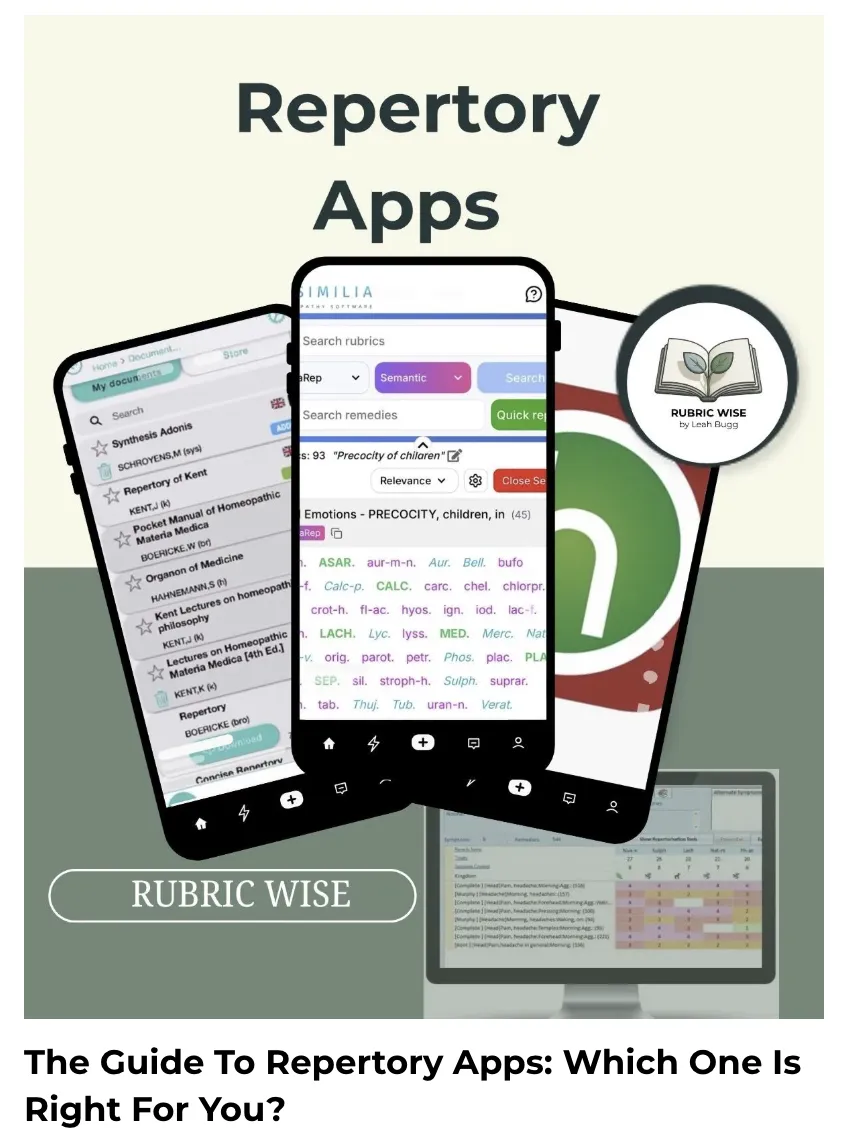
Ideal for students, home prescribers, practitioners on the go, and anyone who needs quick repertory access without committing to a full desktop suite.
Partner With This PAGE
Want your tool listed?
In the ever-changing landscape for technology, we may see new tools developed for repertory work. If you maintain a repertory tool or app and believe it belongs in this overview, share the details and we will review it for a future update.
Reaching out does not guarantee inclusion.
RUBRIC WISE
© Copyright 2026 Rubric Wise | Privacy Policy | Terms & Conditions
All rights reserved. This website is for educational purposes only.