
The Vertical Edge - When Mastery Meets Deep Fear
2017...
In 2017, in Yosemite National Park, Alex Honnold free-solo climbed the face of El Capitan.
That same weekend, I was also in Yosemite. My heart was racing for an entirely different reason, I was saying yes to marrying the love of my life.
At the time, I had no idea Alex Honnold was there. But as a rock climber myself at the time, it felt extraordinary to realize I was in the valley during one of the most historic athletic feats of our time.
This morning, years later, I watched a replay of Honnold’s live free-solo climb of Skyscraper Taipei 101 (available to stream on Netflix). From the safety of my couch, my body reacted as if I were the one climbing. My stomach churned. My throat tightened. Sweat gathered on my palms as I couldn't comprehend what I was seeing.
For Alex, it looked almost effortless. For me, watching him pause mid-climb to wave to the crowd, I had to consciously remind myself to breathe. When he reached the top and leaned back, suspended only by his legs, I thought I might be sick.
Out of curiosity, I repertorized my state.
No surprise, Aconite rose immediately to the top.
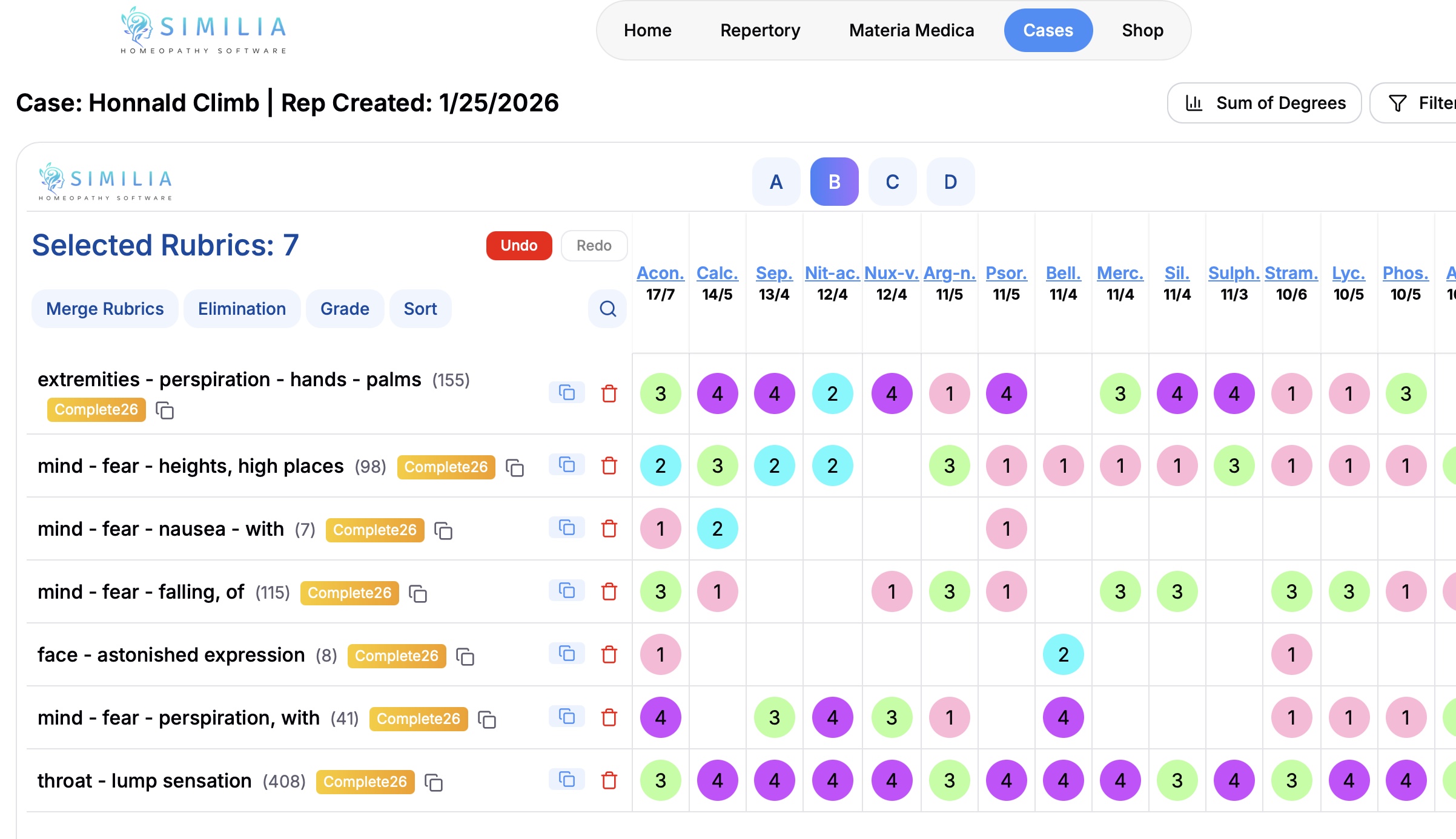
It seemed strange to me that I could be in such a state of fear without actually facing any immediate danger and how powerful the mind can be. A reminder of how the body holds onto what the mind has not resolved.
My relationship with fear and climbing
I have always had a complicated relationship with rock climbing.
I didn’t start climbing until my thirties, and not seriously until I moved to the United States. But once I did, I climbed around three times a week, indoors and outdoors. I was in the best shape of my life and constantly pushing my limits.
But I have to tell you:
I am terrified of heights. And of falling.
I began climbing as a way to meet those fears head-on. Sometimes it worked. Sometimes it ended in complete mental shutdown, where my mind overwhelmed skills my body had already earned. I was strong and I was scared.
Watching Alex climb glass and steel with nothing but shoes, hands, breath, and precision brought me straight back to that primal fear state I knew so well on the rock.
Sometimes I would let the fear paralyze me.
Sometimes it propelled me forward.
Often it brought panic, tears, and at the extreme end, hyperventilation.
Sometimes there was exhilaration after reaching one more hold.
Sometimes self-deprecation for "giving up" too easily.
Climbing required enormous trust: trust in my belayer, trust in the rope, and trust in myself. It also demanded mental preparation I didn’t always have the tools for.
I wish I had known about homeopathy then in the peak of my climbing era. I wish I had understood how to support an acute fear state in the moment when I was unsure that I could go any further up, but letting go of the rock face, to descend, felt too terrifying.
Standing steady at the edge
Watching Alex conquer these amazing challenges, both last time and this time, was not his physical strength. It was his composure.
He remained calm. He breathed. He assessed. He moved forward deliberately, meticulously, without rushing or freezing. One move at a time.
The discipline required to achieve what most of us label “unachievable” is nothing short of extraordinary. It reminds us that fear may always exist, but it does not have to be the one making decisions.
Alex moves through his world with a calm I may never fully grasp. But he continues to inspire me to reach for the next hold anyway.
Fear can be present, without being in control.
Fear as a Language in the Repertory
What this experience reminded me is just how many ways fear shows up in the repertory.
We have rubrics for sudden fear, anticipatory fear, fear with panic, fear with paralysis, fear of actions, fear of others, fear being alone, fear of surroundings, fear at different times of the day, and so on.
Each rubric tells a different story about how the system responds when it perceives threat.
Watching Alex climb, and noticing my own visceral response from a place of safety, reminded me how quickly the body can enter a fear state, or hold onto a memory if it hasn't been uprooted.
Fear rubrics are something I want to explore much more deeply in my upcoming Rubric Wise Academy. Not as a list of rubrics to memorize, but as a way of learning to recognize fear as it actually presents in real people, in real moments. To understand how fear moves, how it resolves, and how different remedies meet it in different ways.
I am actively building a community space for learners who want to understand the repertory. And like my journey with climbing, there is always an element of fear in doing something new, but I hope you will join me when it's ready.
For now, the best way to stay connected is to:
Subscribe to Rubric Wise Weekly
Read along as I break down rubrics, remedy language, and repertory thinking in real life
If you are using Similia software, you can explore rubrics like Mind, fear sudden and Ailments from Fright with greater nuance and cross-referencing.