Understanding Clarke’s Repertory of Causation: A Hidden Gem in Repertory Work
When most of us think about repertories, Kent, Phatak or Synthesis come to mind first — the massive, symptom-focused collections that have shaped homeopathic practice.
But we must not forget other repertories that can bring clarity and clinical usefulness:
John Henry Clarke’s Clinical Repertory to the Dictionary of the
Materia Medica.
Tucked away in the middle of this repertory book is a whole section that speaks to the language of etiology i.e. what caused the disturbance, and similarly to how we have used the Boenninghausen repertory with a CLAMS framework (see here), this section of Clarke’s Clinical Repertory - Repertory of Causation section - is one to know about.
Why Causation Deserves Attention
When a client says, "It all started after..."- that’s a gift that should prick our ears up.
Clarke recognized that these “after” moments can be big clues to the right remedy. His Repertory of Causation section provides a structured way to repertorize from events, not just symptoms.
You’ll find practical entries like:
After fright
After loss of fluids
After wet feet
After bathing in cold water
Each one points to remedies that express the body’s unique way of responding to stress, shock, or environmental change.
A Case Example: Being in Water
Let’s take a simple example from the causation section of Clarke’s repertory:
“After being in water.” (P152 and also under bathing P138)
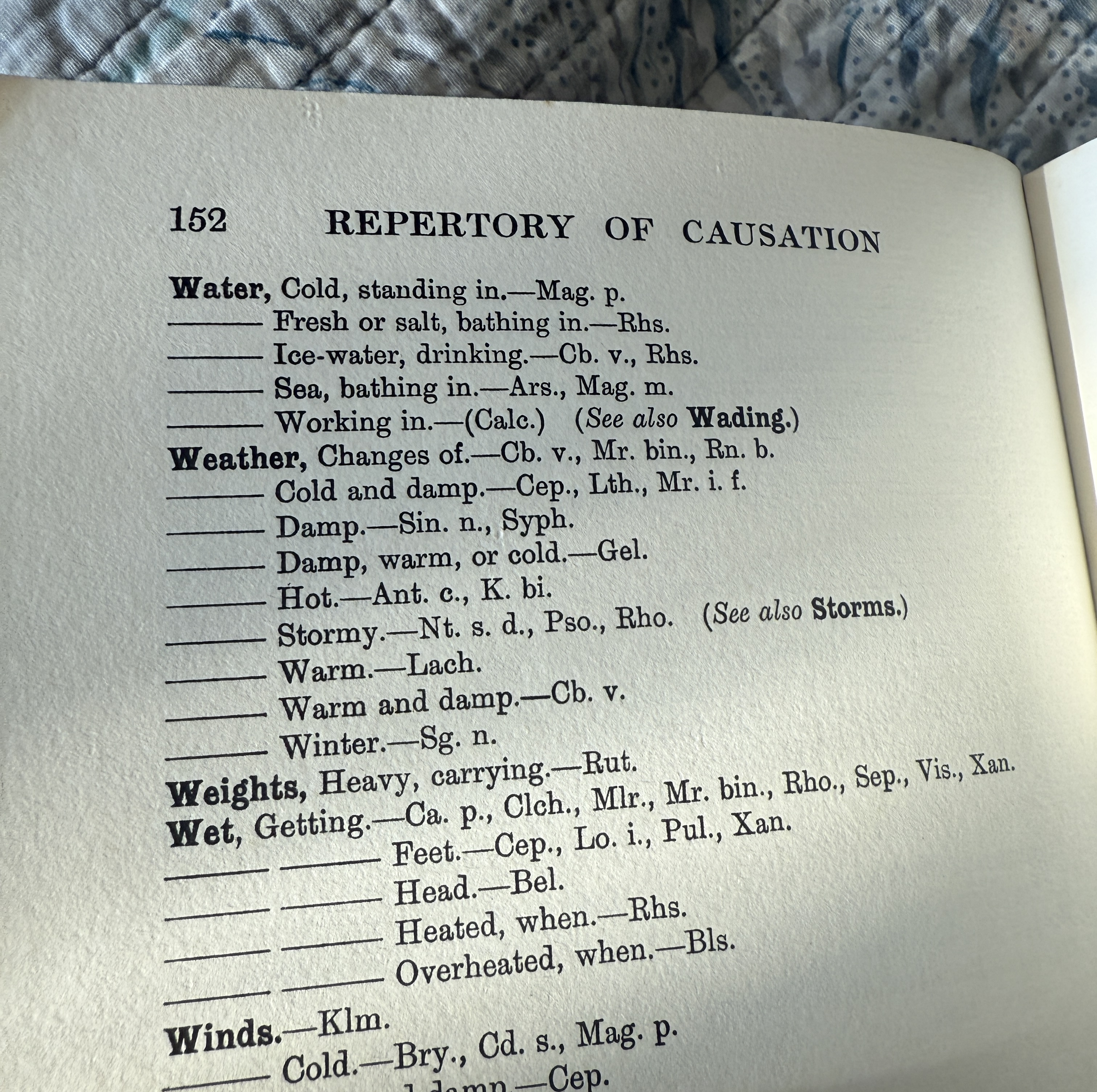
I had a case very early on during Supervision. The client had cold-induced urticaria - that is to say that he experienced hive-like swelling eruptions on his skin after exposure of the skin to cold air.
In this case it all began after he had spent some time in cold sea water trying to free up a tangled line by his fishing boat. He had a clear “beginning” to his symptoms, to tie it back to this specific symptom, - so whenever he got cold, it was like his body remembered that time he was in water for a prolonged period.
I didn’t know about Clarke’s repertory of causation at the time but I came to the remedy Rhus tox for the case, as it fit the overall totality of symptoms well. And here, some time much later I found it in Clarke’s causation repertory under “after bathing in fresh or salt water”.
When you start with the “why might this be happening?,” the “what” starts to make sense.
In a client case, that might mean tracing symptoms back to a grief, a vaccination, a suppression, or, yes - a cold bath.
Working this way helps us:
See causation as part of the case’s logic.
Anchor repertory work in the real events.
Recognize remedy patterns through their reaction to life’s triggers.
Clarke’s causation section asks a simple question: What happened?
And when we have a known cause in the case, that’s a great place to start.
Further Study
If you enjoyed exploring this peek into the repertory, you’ll love the discussions happening inside Rubric Wise Weekly - my weekly newsletter where we look at repertory gems, case work, online tools and tips, and modern applications of classical texts.
And if you’re ready to go deeper into case preparation, rubric selection, and analysis, I’m getting ready to announce RubricWise Case Companion - a one-to-one discussion designed for students who want support to sharpen their repertory skills.
Stay tuned for early access in the next newsletter.